How Direct Inward Dialing Unlocks Hyper-Personalized AI Agents
Most people hear "Direct Inward Dialing" and picture a dusty telecom manual from 2003. It sounds like legacy infrastructure, something your IT team set up years ago and nobody thinks about anymore. But DID is anything but obsolete. In fact, Direct Inward Dialing has quietly become one of the most powerful levers driving next-generation voice AI performance. If you are building or deploying AI agents for customer service, you are leaving serious efficiency on the table without it.
The phone number itself is data. Direct Inward Dialing turns that data into a head start on every single call before your AI says a word.
Here are two numbers that frame the opportunity:
- Businesses that deploy specialized, purpose-built AI agents per function tend to see lower average handle times and higher first-call resolution than those running a single generalist model. (Freshworks CX Benchmark 2025)
- Even small pauses in conversational AI, as little as 2 to 3 seconds of dead air, cause measurable drops in customer satisfaction, making routing latency one of the highest-leverage variables in voice AI deployment. (Voximplant)
What Direct Inward Dialing Actually Is
At its core, Direct Inward Dialing is a telephony service that lets businesses assign dedicated phone numbers, called DID numbers, directly to specific people, departments, or functions. Callers reach their destination without going through a receptionist, a switchboard, or an IVR menu. The number itself carries the routing instruction.
Traditional phone systems connected callers to a central PBX (Private Branch Exchange) and then relied on a human operator or automated menu to figure out where to send them. DID changes that by mapping each external number directly to an internal extension, queue, or workflow.
In modern deployments, this works through SIP trunking. Rather than physical telephone lines, SIP trunks create virtual connections over the internet that link your DID numbers directly to a voice AI agent. The call path is cleaner, faster, and fully software-defined. You configure and scale it without touching hardware.
Voice AI is the brain. Direct Inward Dialing is the nervous system. Without the right routing infrastructure, your inbound call handling suffers, your customers notice, and your costs climb.
The Problem With Running Everything Through One Line
When a voice AI agent sits behind a single main number, it faces the same bottleneck as the old IVR. It answers cold, parses open-ended speech, determines intent, and then responds. All of that processing takes time, and customers feel every second of it.
That 2-to-3-second silence at the start of a call is call routing latency, and it causes a measurable drop in customer satisfaction. We call it the "IVR Tax." You upgraded from IVR menus, but rebuilt the delay in a different form. A properly configured Direct Inward Dialing setup removes that bottleneck before the AI model even enters the picture.
How DID Eliminates Dead Air and Cuts Handle Time
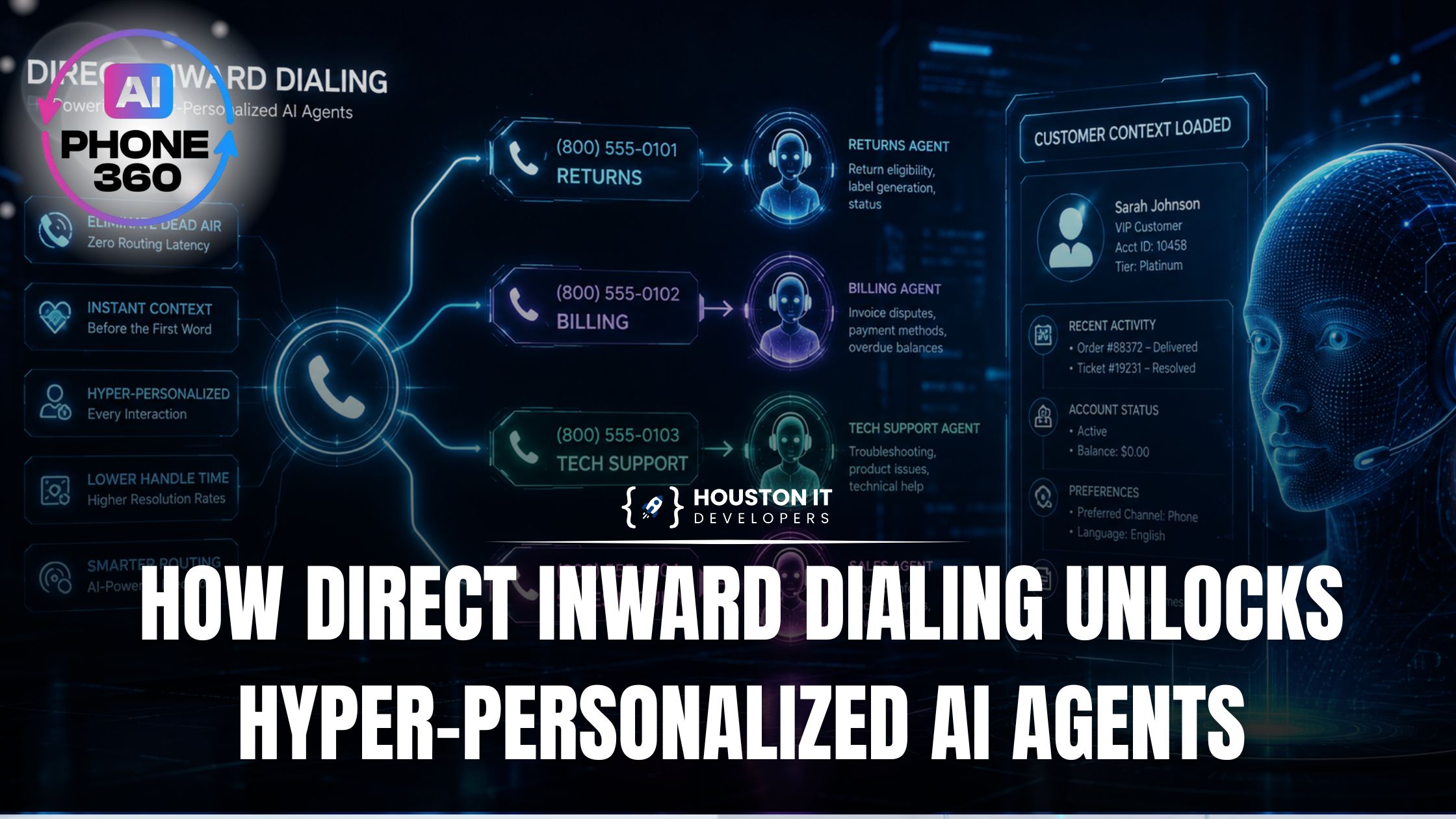
With Direct Inward Dialing, each DID number points directly to a predefined destination with all its context already loaded. When a customer dials that number, the SIP trunk connects and the AI already knows exactly why they called. There is no guessing, no parsing open-ended speech to determine intent, and no 2-second silence. The intent is encoded in the number itself.
Here is what that looks like in practice:
- A customer calls the dedicated billing support DID. The voice AI agent answers already knowing this is a billing call, skips discovery entirely, and goes straight to resolution.
- A VIP account holder calls the enterprise DID assigned to their account tier. The AI pulls their data instantly before the first word is spoken.
- A user clicks a call-to-action on a landing page tied to a campaign DID number. The AI already knows what offer the customer saw before dialing.
The impact on average handle time (AHT) is significant. Less time spent on intent recognition at the start of every call adds up fast across thousands of daily interactions.
Instant CRM Integration and Zero-Question Authentication
The real power of DID in a voice AI system is what it enables on the data layer.
When a customer dials a dedicated DID number, that number acts as a metadata tag. The moment the call initiates, the system uses the incoming DID to trigger an immediate API lookup in your CRM, whether that is Salesforce, HubSpot, or any other platform your team runs on. This happens before the AI picks up.
By the time the customer hears a greeting, the AI already holds the caller's name, account status, open tickets, and recent purchase history. Instead of "Can I get your account number?" the AI says "Hi Sarah, I can see your shipment is arriving tomorrow. Are you calling to make a change to the delivery window?"
That is what hyper-personalization actually means. Not an AI that sounds friendly, but an AI that already knows the situation. The DID can also pre-verify the caller in many scenarios, cutting identity confirmation time on high-volume calls like billing or account management.
Assigning AI Specializations to Distinct DID Numbers
There is a common temptation when building enterprise voice AI: build one large model that knows everything. This approach sounds clean. In practice, it is expensive, slower, and prone to hallucinations. A single, monolithic model loaded with every policy, every product line, and every compliance rule is harder to maintain and more likely to generate inaccurate responses.
The smarter voice bot architecture uses purpose-built, specialized AI agents, and Direct Inward Dialing maps specific DID numbers directly to each one.
| DID Number | AI Agent | Scope |
|---|---|---|
| (800) 555-0101 | Returns Agent | Return eligibility, label generation, status |
| (800) 555-0102 | Billing Agent | Invoice disputes, payment methods, overdue accounts |
| (800) 555-0103 | Bilingual Triage Agent | Spanish-first routing, escalation paths |
| (800) 555-0104 | Tech Support Agent | Tier 1 technical troubleshooting |
| (800) 555-0105 | Enterprise Account Agent | Dedicated VIP tier, SLA-aware responses |
Each agent is small, focused, and highly accurate within its domain. LLM specialization consistently outperforms generalist models on domain-specific tasks because the context window is not overloaded with irrelevant information. Smaller models also require less compute per call, and at high call volumes that infrastructure cost difference becomes material.
Localized Virtual Numbers, Regional Compliance, and Caller Trust
By deploying local area code DID numbers across different states or regions, you can trigger dynamically loaded AI personas calibrated for that market. When a call routes through a Texas DID number, the AI can load a different configuration than when a call routes through a New York DID. That configuration can include regional phrasing, localized pricing or service details, and state-specific compliance scripting.
That last point is not optional in many industries. TCPA obligations, call recording consent disclosures, and financial services regulations all vary by state. A California caller may require a different disclosure script than a Florida caller. Tying the script to the DID reduces legal risk as much as it personalizes the call.
Customers are also more likely to complete a service interaction when the system they reach feels locally relevant. Virtual phone numbers make it feasible to serve a customer in rural Tennessee and one in San Francisco appropriately, from the same underlying platform.
How AI Phone 360 Puts DID to Work
At AI Phone 360, dedicated numbers are not a bolt-on afterthought. They are baked into how the platform routes, contextualizes, and personalizes every call from the moment it comes in.
- Multiple numbers, one platform. You can add multiple numbers to your account and point them at different services, campaigns, or locations from your AI Phone 360 dashboard, each answered by your AI trained on your specific business content.
- Pre-call CRM context. Our integrations layer connects to Salesforce, HubSpot, and 15+ tools, so by the time the AI greets a caller it can draw on who they are instead of asking for an account number.
- No cold-start dead air. Because the number a caller dials already signals intent, the AI can skip open-ended discovery and get to the point. Callers notice the difference immediately.
- Custom rules and scripts. You can set custom AI rules for how the AI greets and what it says — including disclosures — so the right script runs for the right audience.
- Setup in 90 seconds. No telecom engineer needed. Pick your numbers, define your routing rules, and the platform handles the phone infrastructure for you.
Try the AI live in your browser with no credit card required, or explore pricing plans for your call volume. For multi-location or enterprise deployments, our virtual receptionist solution shows how dedicated-number routing scales without adding headcount.
Final Thoughts on Direct Inward Dialing
Direct Inward Dialing is not legacy infrastructure. It is the routing layer that makes voice AI actually work in production. It eliminates dead air, enables pre-call CRM context, keeps compliance scripting accurate by region, and supports specialized agents at scale.
Ready to see it in action? Create your AI Phone 360 account and start building intelligent voice workflows today. You can also install AI Phone 360 on the App Store or Google Play to manage your calls from anywhere.
FAQs
What is a direct dial number?
A direct dial number, also called a DID number or DDI in European markets, lets callers reach a specific person, department, or AI agent without going through a receptionist or switchboard. The number itself carries the routing instruction.
What is the difference between DDI and DID?
They describe the same capability. DID (Direct Inward Dialing) is the term used in North America; DDI (Direct Dialing Inward) is more common in Europe.
Does DID require a physical phone line?
No. Modern DID deployments run over SIP trunking, using VoIP and internet connections instead of physical PSTN lines. DID numbers are scalable and fully configurable in software.
What is #21 used for?
#21 is a carrier feature code that can display or manage call-forwarding settings on supported devices. It is unrelated to Direct Inward Dialing.