AI for Call Centers: Chatbots vs Voice AI vs Hybrid Solutions
Have you ever waited on hold for what felt like forever, only to get transferred multiple times before finding help? This frustration is one reason businesses are investing in AI for call centers.
Reports suggest that by 2025, nearly 80% of companies will be using or planning to adopt AI-powered chatbots for customer support. Customers also show a clear preference for speed, with 61% favoring a fast AI response over waiting for a human, and most valuing the quickness of chatbot interactions.
The challenge for many businesses is deciding which type of call center AI to use. Should they rely on text-based chatbots, voice-driven systems, or a mix of both? In this post, we explore the strengths of each artificial intelligence call center approach, and help you determine which option can best serve your customers and support your business goals.
Understanding the Three AI Approaches for Call Centers
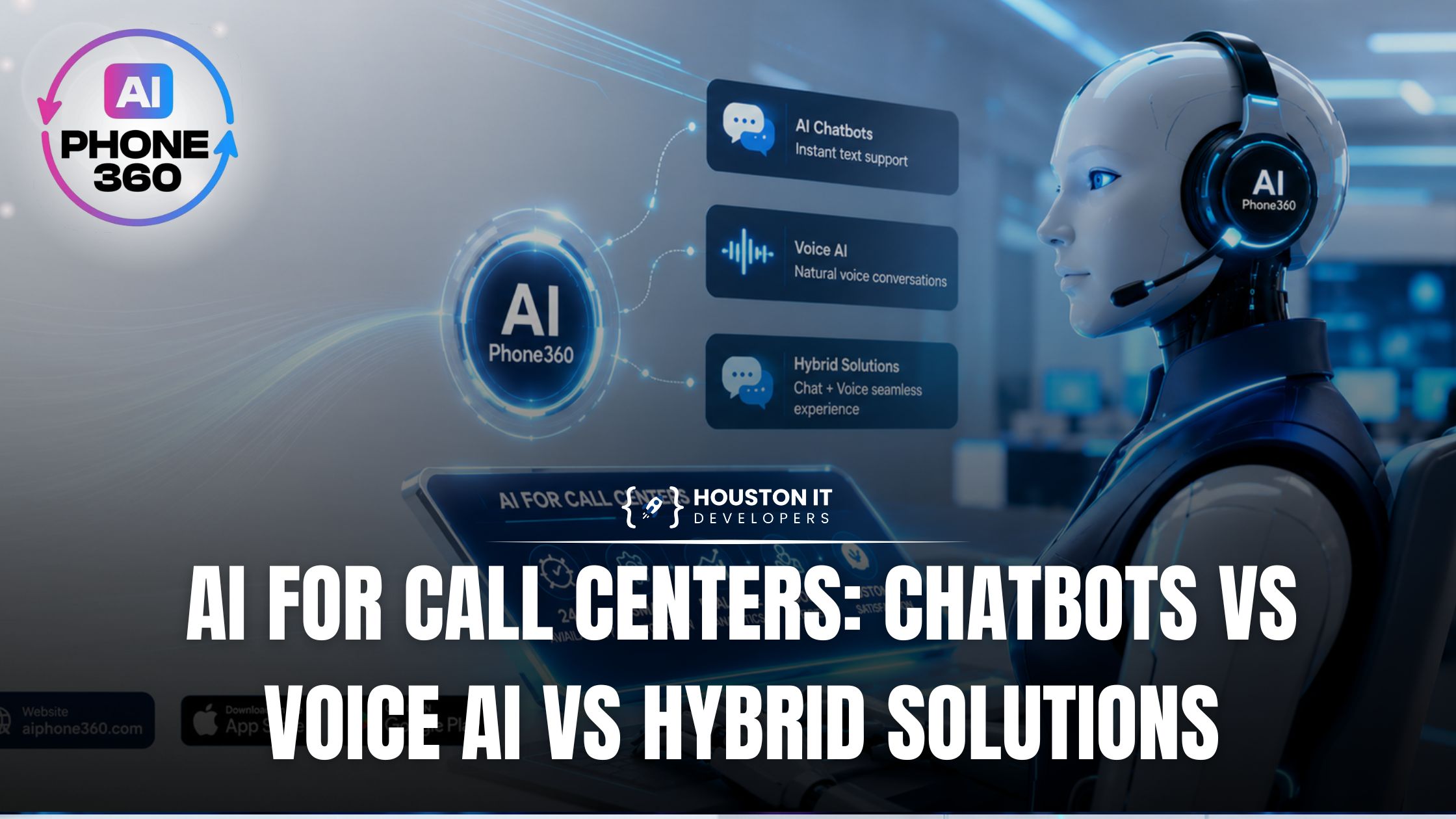
The growing adoption of AI for call centers has introduced three primary approaches: chatbots, voice AI, and hybrid solutions. Each addresses different customer needs and offers unique benefits. Chatbots work through text, handling questions and routine tasks through messaging platforms and live chat. Voice AI delivers spoken interactions that mimic natural conversations, providing an alternative to traditional phone support. Hybrid systems combine the two, offering flexibility for businesses that want to cover both digital and voice channels efficiently.
Key distinctions between these AI models include:
- Chatbots: handle FAQs, order tracking, and quick resolutions through text-based platforms.
- Voice AI: manages phone conversations, understands customer intent, and responds in real time.
- Hybrid solutions: blend chatbots and voice AI, offering smooth cross-channel experiences and seamless agent handoffs.
Understanding these three categories lets decision-makers evaluate how artificial intelligence call center tools align with their customer service strategy. By identifying priorities such as scalability, personalization, or channel coverage, leaders can choose the most effective call center AI to meet both operational and customer expectations.
Chatbots: Text-Based Customer Service Automation
Chatbots are among the most practical and scalable AI-for-call-center technologies, built to handle large volumes of customer interactions efficiently. Unlike static FAQ pages, chatbots use natural language processing (NLP) and machine learning to understand queries, interpret intent, and deliver accurate responses in real time.
They can manage tasks ranging from booking appointments and tracking shipments to troubleshooting technical issues. Their ability to integrate across websites, mobile apps, and messaging channels makes them versatile tools for businesses that need around-the-clock support without overloading human agents.
| Feature | How It Benefits Call Centers | Example Use Case |
|---|---|---|
| 24/7 Availability | Continuous support without staffing overnight shifts | Handling inquiries after business hours |
| Scalability | Manages thousands of conversations simultaneously | Seasonal surges in e-commerce orders |
| Task Automation | Streamlines repetitive processes, reduces agent workload | Resetting passwords or processing returns |
| Cost Efficiency | Lowers dependency on human resources for routine work | Automating common entry-level support requests |
| Data Collection | Captures customer insights for analytics and improvement | Identifying common issues for product development |
Despite their strengths, chatbots come with limitations. They often struggle with complex or emotionally sensitive queries, which can frustrate customers if escalation to a human agent is not seamless. Over-reliance on chatbots may also create an impersonal experience, weakening loyalty in industries where empathy is critical. Deployment also requires ongoing investment in training data, monitoring, and updates to keep responses accurate and compliant. These considerations highlight the importance of balancing automation with human support.
Voice AI: Conversational Phone Support Systems
For companies that continue to depend on phone-based communication, voice AI represents a powerful upgrade to the traditional artificial intelligence call center model. Instead of relying on outdated interactive voice response (IVR) menus that frustrate customers, voice AI uses advanced speech recognition and natural language understanding to interpret customer intent. This lets the system respond with dynamic, human-like interactions in real time. Unlike static scripts, voice AI can detect tone, adjust responses based on sentiment, and route calls more intelligently, creating smoother customer journeys.
Key benefits of voice AI in call centers include:
- Natural conversations: engages callers in more human-like dialogue than rigid automated menus.
- Real-time assistance: resolves issues instantly, reducing long hold times.
- Personalization: uses data and context to tailor responses to individual customers.
- Identity verification: speeds up authentication with voice biometrics.
- Efficient call routing: directs customers to the right department without multiple transfers.
- Scalability: handles spikes in call volume without additional staff.
Industries such as healthcare, financial services, travel, and telecommunications benefit greatly, as their customers often prefer voice interactions when dealing with sensitive information or urgent issues. While chatbots excel at text-based automation, voice AI offers a more personal and responsive experience for phone support, making it a vital tool for businesses aiming to improve efficiency and customer satisfaction at once.
Hybrid Solutions: The Best of Both Worlds
Not every call center can rely solely on chatbots or voice AI. Many organizations serve diverse customers with varying communication preferences, which makes hybrid solutions attractive. A hybrid setup integrates both text-based chatbots and conversational voice AI into a single artificial intelligence call center framework. This gives customers the freedom to choose how they interact, whether through instant messaging or a real-time phone call, while still leveraging the power of automation.
Key advantages of hybrid call center AI include:
- Omnichannel support: consistent service across chat, mobile apps, and phone calls.
- Seamless escalation: smooth handoffs from AI to human agents with full context of the customer's query.
- Operational efficiency: AI handles repetitive tasks before a live interaction is needed.
- Customer flexibility: adapts to different demographics, from younger users who prefer messaging to customers who prefer phone conversations.
- Data unification: combines insights from both chat and voice channels for better analytics.
- Future readiness: scales and adapts as new communication platforms and AI technologies emerge.
Hybrid solutions bridge the gap between automation and human touch. A chatbot might handle appointment scheduling through text while voice AI manages urgent billing inquiries. If either system hits a complex issue, the customer transfers to a human agent with full context preserved. This combination delivers speed, personalization, and reliability, making hybrid systems one of the most future-proof approaches for businesses investing in AI for call centers.
Choosing the Right AI Solution for Your Call Center
Selecting the best AI for call centers is not simply about choosing the latest technology. It requires aligning your solution with business goals, customer expectations, and operational realities. The right choice depends on where your customers interact most often, the complexity of inquiries, and how much automation your team can realistically manage. A thoughtful evaluation ensures the technology strengthens, rather than disrupts, the customer experience.
| Factor to Consider | Why It Matters | Best Fit |
|---|---|---|
| Primary communication channel | App- and website-first businesses benefit from instant text | Chatbots |
| Customer preference | Some prefer quick chats, others value phone for complex matters | Voice AI or Hybrid |
| Nature of inquiries | Routine questions automate easily; sensitive issues need conversation | Chatbots simple, Voice AI complex |
| Integration with existing systems | AI should connect with CRMs, ticketing, and databases | Hybrid for flexibility |
| Scalability and growth | Rapid growth needs solutions that expand without driving up costs | Chatbots or Hybrid |
| Compliance and security | Healthcare and finance must prioritize secure interactions | Voice AI with authentication |
Ultimately, the decision comes down to balancing automation with human support. A call center AI solution should not only reduce operational costs but also strengthen brand trust by meeting customers where they are. By carefully evaluating these factors, businesses can choose between chatbots, voice AI, or a hybrid model with confidence.
Why Businesses Are Choosing AI Phone 360
In today's fast-paced business environment, customer expectations are higher than ever. People want instant answers, personalized experiences, and seamless support no matter what time of day they reach out. Traditional call centers often struggle to meet these demands due to high overhead, limited hours, and reliance on human agents who can only handle so much at once.
AI Phone 360 changes the game. If you want to move beyond the limitations of outdated systems and tap into AI-driven customer service, this platform is designed for you. Unlike generic automation tools that sound robotic and lack context, AI Phone 360 responds with your own tone and voice, powered by a deep understanding of your business. The result is a natural, human-like interaction that makes every caller feel heard and valued.
With AI Phone 360, you can do the following:
- Never miss a call, day or night — every customer interaction is answered promptly, even outside normal business hours.
- Clone your voice for personalized interactions — maintain brand consistency by greeting customers in a voice that sounds like you.
- Offer 24/7 call answering with instant responses — eliminate wait times and provide instant solutions to common queries.
- Automate appointment scheduling with calendar integration — connect callers to your availability without back-and-forth emails.
- Track calls, notes, and follow-ups in real time — keep a complete record of every interaction for better customer insights.
- Use built-in CRM integration to streamline workflows — connect your existing systems for a smoother sales and support process.
- Deliver customer experiences in 30+ languages — break down language barriers and expand your reach to global markets.
Traditional call centers can drain budgets with staffing, training, and infrastructure, and they have limits when it comes to scalability and consistency. AI Phone 360 offers a smarter alternative, giving you speed, accuracy, and room to grow at a predictable flat rate. Businesses that adopt it not only save money but also deliver customer service that feels faster, more reliable, and more personal.
In a world where every missed call could mean a missed opportunity, AI Phone 360 helps you stay always available, always professional, and always ready to serve.
Final Thoughts on AI for Call Centers
AI for call centers is no longer a trend, it is the foundation of modern customer service. Chatbots deliver fast, text-based automation, voice AI provides real-time and personalized phone support, and hybrid solutions blend both to create flexible, omnichannel experiences. The right choice depends on your customer base, industry, and growth strategy, but adopting artificial intelligence call center tools improves efficiency, reduces costs, and strengthens customer loyalty.
If your goal is to future-proof your operations, now is the time to act. Start by evaluating your current pain points, then explore how chatbots, voice AI, or hybrid systems align with your business goals.
AI Phone 360 makes it easy to take the next step. Sign up today and experience how AI can transform your customer service, or download the app on the App Store or Google Play to get started.
FAQs
How is AI used in call centers?
AI in call centers automates routine tasks, improves response times, and enhances the customer experience. Chatbots manage text-based interactions like FAQs, order tracking, and simple troubleshooting. Voice AI handles real-time phone conversations, recognizing speech, detecting sentiment, and routing calls intelligently. AI also supports live agents with real-time suggestions, customer insights, and call analytics.
Is AI taking over call centers?
AI is not fully replacing call centers but transforming them. Automation reduces the need for human agents on repetitive tasks, but most businesses still need people for complex, sensitive, or emotional issues. Instead of taking over, AI augments call centers by cutting costs, reducing wait times, and letting agents focus on higher-value interactions. The future is more about collaboration between AI and humans than replacement.
Can I use AI for customer service?
Yes. AI-powered tools like chatbots, voice assistants, and hybrid platforms can be built into websites, apps, and phone systems for faster, more consistent service. Many small and large businesses already use call center AI for appointment scheduling, billing support, and identity verification. The key is choosing the setup that aligns with your customer needs and business goals.